

24*7 access anytime anywhere










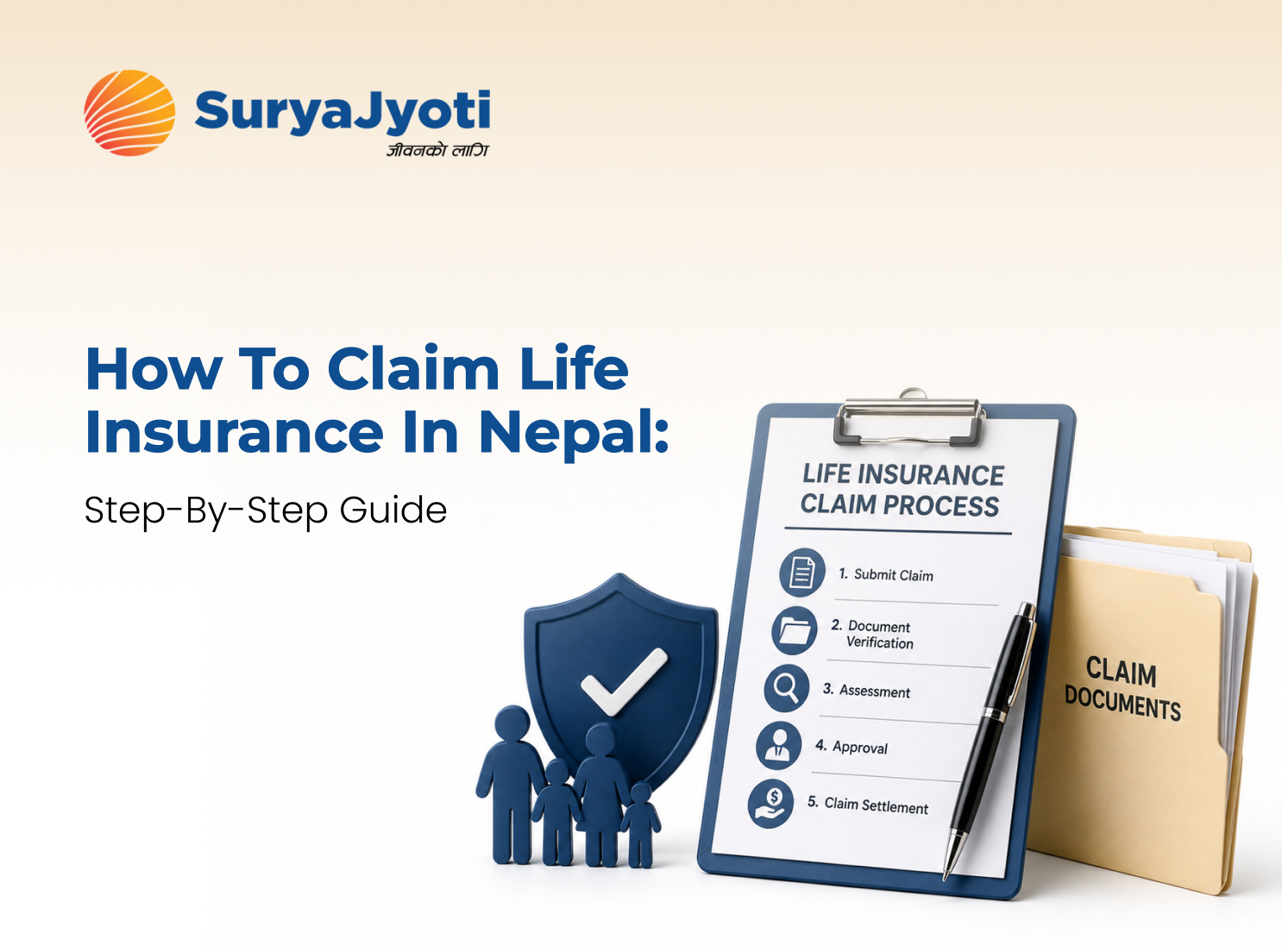
Most people spend a lot of time considering which insurance plan to purchase and little time contemplating what happens when it's time to pay the payout.
That is understandable. When you are signing the policy at the age of 28, the claims sound so far away.
But when the time comes that either a relative or partner has passed, or your policy has matured after 20 years of premiums, you want to know what happens and what to do.
One of the best things a policyholder can do is know how to claim life insurance in Nepal well in advance, before they even need it.
Here is the complete step-by-step process in layperson's terms: the kinds of claims, the documents you will need, how long it takes, and where your rights lie if it doesn't go as planned.
Before delving into the steps, it is important to recognize that claiming life insurance in Nepal is not a single process. This will depend on the circumstances of your claim.
This is when you survive to the end of your policy term.
You were covered throughout, and now the policy has done its job.
The sum assured and bonuses earned are due to be paid to you. This is the most common claim among endowment and money-back policyholders.
This is when the policyholder dies during the policy term. The nominee listed in the policy can demand the sum assured, along with applicable bonuses and any extra rider benefits, from the insurance company.
If your base policy includes riders such as the Accidental Death Benefit, Critical Illness, or Total Permanent Disability, these may generate a separate claim in addition to the base sum assured.
For instance, SuryaJyoti Life offers a Critical Illness Rider that pays a lump sum upon diagnosis of any covered critical illness, regardless of the death/maturity event.
Policyholders who opt for money-back plans can receive a certain amount from the sum assured at regular intervals.
These are not full claims in the traditional sense, but they do require you to be in contact with your insurer at the right time.
This is helpful to know from the start, as it allows you to know what is coming and when.
The first step in claiming life insurance in Nepal is knowing which type of claim applies to your situation.
A maturity claim is the easiest to predict of all claims since the policy end date is always known and fixed. Here is what the process looks like in practice.
According to the Insurance Claims Settlement Guidelines 2024, insurance companies must issue a maturity notice within 15 days of the policy maturity date, requesting the original policy document and identity verification documents to process payment.
As your policy nears maturity, SuryaJyoti will proactively get in touch with you.
Please contact the team in the SuryaJyoti services portal or directly at one of the team's branches through the network points finder if you have not received anything within 1-2 weeks of the maturity date.
Typically, the following is required for a normal maturity claim:
Original policy bond (the physical policy document issued at the start)
A valid identity document (citizenship certificate or passport)
Details of your bank account for the transfer of the payout.
If requested, any receipts or confirmation of premium receipt from the past.
Store all these in a single location. If you have misplaced your original policy bond, contact your insurance team early so they can guide you through the duplicate issuance process before the maturity date arrives.
Documents can be submitted to any SuryaJyoti outlets or via their online portals. After all documents have been received, the insurance company must be satisfied of liability and pay the claim within 15 days of receipt of all documents.
The sum assured, along with all the accumulated bonuses, goes straight to your bank account.
For participating plan policyholders, this includes every year of bonus that has been accumulating on your policy since it started, often a significant addition to the base sum assured.
The description of the methods of bonus declaration and accumulation is listed on the SuryaJyoti bonus rate page.

The nominee of the deceased policyholder files a death claim. It comes at the most difficult time when a family is already dealing with loss.
That's why it's important to know the process ahead of time.
Upon the occurrence of a covered event, the claimant should give formal intimation to the insurance company.
The insurance company will send a letter stating all the required documents for processing the claim based on the intimation received.
Contact SuryaJyoti through their contact page or visit the nearest branch.
It's not necessary to have all documents prepared at this stage. The clock begins when you inform the company, and the formal process begins.
In Nepal, the typical documents necessary for a death claim are:
Death certificate issued by the relevant local government authority (Palika or municipality)
Original policy bond
Nominee's identity document (citizenship certificate or passport)
Claimant's declaration form, provided by the insurance company
Medical attendant's certificate or hospital records, if the death was due to illness
Police report and post-mortem report, if the death was accidental or unnatural
For the Accidental Death Benefit rider specifically: FIR and post-mortem report confirming the cause of death
If the deceased was the primary earner and the family is under financial pressure, SuryaJyoti's agent network can help gather and organize documents.
This claim philosophy page on the SuryaJyoti website presents SuryaJyoti's commitment to the timely and proper processing of claims.
Each document is submitted to the nearest Insurance branch and/or via the official route. The company registers the claim and issues a formal acknowledgment.
Under Nepal's Insurance Act 2079, insurance companies must settle claims within 30 days after receiving all required documents.
SuryaJyoti’s internal target is 15 working days from the date of full document submission. The sum insured, along with the bonus accrued upon it, is credited to the bank account of the nominee.
If you had a critical illness policy or disability policy, you would follow the same claim process but perform a separate benefit calculation.
When your policy has a Critical Illness Rider, you make your claim for Critical Illness alongside your policy.
However, the policy doesn't stop when a critical illness claim is made. It keeps going.
The documents required for a critical illness claim include:
Formal notification to the insurance company
Diagnosis certificate from a recognised hospital or specialist
Medical records confirming the diagnosis of the covered condition
Your identity document
The lump-sum payout, up to Rs. 50,00,000 under SuryaJyoti's critical illness coverage, is paid directly on diagnosis, not after recovery, and not only if you pass away.
The Critical Illness FAQs page lists the covered conditions and explains how claims under this critical illness rider are settled.
This is a worry that most policyholders keep to themselves. Knowing your rights removes that uncertainty.
Timely claim settlement is the policyholder’s right under the Nepal Insurance Act 2079. If claim settlement is delayed or unfairly rejected, the policyholder can lodge a formal complaint directly with the Nepal Insurance Authority (NIA).
The NIA monitors the settlement ratio of claims across all insurers and initiates enforcement action against insurers with poor settlement ratios.
SuryaJyoti also has a grievance mechanism for the policyholders whose grievances have not been resolved to their satisfaction.
This is a formal complaints procedure: A complaint made here is followed up on and is expected to be answered within a set timeframe.
If the internal process does not resolve the issue, the NIA complaint mechanism is the next step.
Understanding that this framework exists changes the dynamic. You are not at the mercy of the insurer. You have rights that are codified in Nepal's Insurance Act and enforced by the regulator.

These save time and stress at claim time, and most involve little to no up-front effort.
Both maturity and death claims will require the original policy bond. Keep it in a safe place and let your nominee know where it is.
Once it gets lost, it takes time to duplicate the process.
In case your nominee's name/relationship/contact information has changed since you purchased the policy, make sure to update the nominee information to your insurance company before any claim arises.
If nominee information is old or out of date, it can significantly delay a death claim.
If a policy has lapsed, it cannot be claimed in full.
SuryaJyoti accepts premium payments via the online payment page, using the following means: eSewa, Khalti, FonePay, ConnectIPS, and NIC Asia Bank.
Setting a reminder around your premium due date costs nothing and prevents a lapse.
Many people are not aware of the riders included in their policy.
A family claiming on a life insurance policy may not realize that the Accidental Death Benefit rider doubles the benefit in the event of an accidental death.
To fully understand all benefits you are entitled to, read through your policy document and/or consult your agent.
SuryaJyoti mobile app allows you to view policy information, premium history, and even communicate with the company.
Keeping it updated means you always have your policy information on hand.
If you have specific questions about your current policy's claim process, the Insurance FAQs cover the most common questions in plain language, and the team is reachable through the contact page.
Nepal's Insurance Act 2079 requires insurance companies to settle claims within 30 days of receiving all necessary documents.
SuryaJyoti's internal target is 15 working days from the date the complete document is received.
The nominee named in the policy at the time it was taken out.
If no nominee was designated, the deceased’s legal heirs can file the claim, though the process requires additional documentation to establish the legal relationship.
For a maturity claim: original policy bond, identity document, and bank details.
For a death claim: death certificate, original policy bond, nominee's identity document, claimant's declaration form, and medical or police records, depending on the cause of death.
A fully lapsed policy generally cannot be claimed. However, if the policy had a paid-up value before lapsing, a reduced benefit may still be available. Contact SuryaJyoti directly to understand your specific situation.
Life insurance coverage applies worldwide as long as the death occurs within the validity period of SuryaJyoti life insurance policies and all premiums are up to date.
Yes. SuryaJyoti's services portal and mobile application help the policyholder keep track of policy- and claim-related communication.
If your family cannot claim a life insurance policy when it is needed the most, then it is the policy that is not serving its purpose to that extent.
Understanding the process for claiming life insurance in Nepal, the essential documents, legal timelines, and your rights in case of unforeseen complications is valuable information for every policyholder to have before it's too late.
SuryaJyoti has developed its claim procedure based on transparency and speed.
The claim philosophy page, grievance-handling mechanism, and the goal of 15 working days for internal settlement are not only stated intentions but are institutional commitments.
With more than 36 lakh outstanding claims and 200 branches across Nepal, the claims infrastructure to support those numbers is not theoretical.
If you're looking to know what your current policy is and how to initiate a claim, the Insurance FAQs are the perfect place to start.
And if you are yet to take out a policy at all, the guide on what happens to Nepali families without life insurance is worth reading before you delay any further.
For those comparing plan types to make the right choice, the blog on term life insurance versus endowment plans in Nepal clearly lays out the decision.
When a claim comes, the family should not have to figure out the process from scratch. That is what this guide is for.



 Services



 Transparency Dashboard